Quickly compare national averages and real offers so you can decide if a refinance fits your goals. Weekly national data shows common programs near mid-6%: a 30-year fixed refinance at 6.77%, 15- and 10-year fixed at 6.05%, and a 5/1 ARM at 6.15%. Stay informed about the latest refi mortgage rates to make the best financial decision.
The average 30-year interest rate dipped to 6.61% on Aug. 13, 2025, the lowest in nine months, while refinance activity climbed with the MBA Refinance Index up 8% year-over-year.
Use this snapshot to scan current rate offers, estimate your monthly payment, and compare full loan terms. Look past the headline rate: consider points, fees, and the payment over time.
If you have a higher-rate mortgage now, even a modest interest drop can trim years off your loan or cut your payment. Keep lender quotes nearby and be ready to act when a number meets your target.
Topic Basics
Your path to a lower payment starts here
Please determine your primary goal first. Do you want a lower monthly payment, a shorter term to save on interest, or cash for a project? Naming your objective helps you pick the right loan structure and target rate.


Next, estimate your new monthly payment using a calculator. Compare that payment to your current one to see if the upfront costs make sense.
Shop smart and swiftly. Get quotes from several lenders on the same day. Shortlist two or three offers that match your budget and timeline.
- Confirm amounts: Make sure the loan will cover your payoff and any rolled-in costs.
- Ask for a cost breakdown: Points, third-party fees, and credits affect your breakeven.
- Choose term wisely: A longer term lowers your monthly obligation but may raise total interest.
- Mind the timeline: Coordinate the process and lock your rate before key financial events.
Stay organized with documents so you can move from application to approval quickly and lock the best offer in time.
Today’s refinance mortgage rate snapshot in the United States
Today’s snapshot shows national refinance offers clustered in the mid-6% band, with clear trade-offs by term, reflecting current refi mortgage rates. You can use this view to weigh steady payments against faster payoff.
Fixed vs. ARM trends and national averages
Fixed-term pricing favors stability. The 30-year fixed averages about 6.77%, giving predictable monthly payment and long-term planning.
Shorter fixed terms—15- and 10-year—sit near 6.05%. They raise your monthly cost but cut total interest and build equity faster.
Program highlights: 30-year, 15-year, 10-year, and 5/1 ARM
- 30-year fixed (≈6.77%) — steady payment and less short-term shock.
- 15- & 10-year fixed (≈6.05%) — higher monthly payment, lower interest paid over the loan period.
- 5/1 ARM (≈6.15%) — lower initial rate for about five years, then adjustments may change your payment.
The average 30-year interest rate fell to 6.61% on Aug. 13, 2025, the lowest in nine months, and MBA data shows refinance activity up 8% year-over-year. Economists expect numbers to hover around the 6.5% percentage for the rest of 2025, though a recession could shift them lower.
When you shop, ask each lender for scenarios with and without point purchase so you can compare APR and upfront amount.
refi mortgage rates: how to find, compare, and lock today
Shop smart and act fast. Gather same-day quotes from several lenders so market swings don’t distort your view. Ask each lender for a complete Loan Estimate to see the full annual percentage rate and fees.
Improve your quote: credit score, equity/LTV, and timing
Focus on credit first. A stronger credit profile can lower the interest rate and cut total costs over the life of the loan.
- Examine similar situations: ask each lender for the same loan amount, term, and lock period to ensure a fair comparison.
- Compare the interest rate and APR side by side—APR shows fees and points for the true percentage rate cost.
- Evaluate LTV: more equity can remove insurance and unlock better pricing or discount options.
- Confirm lock terms and any float-down features, and plan timing around appraisal and underwriting milestones.
Keep clear notes on each quote, including points, origination fees, and prepaid costs, so you can pick and lock the best offer when numbers align.
What drives your refinance interest rate
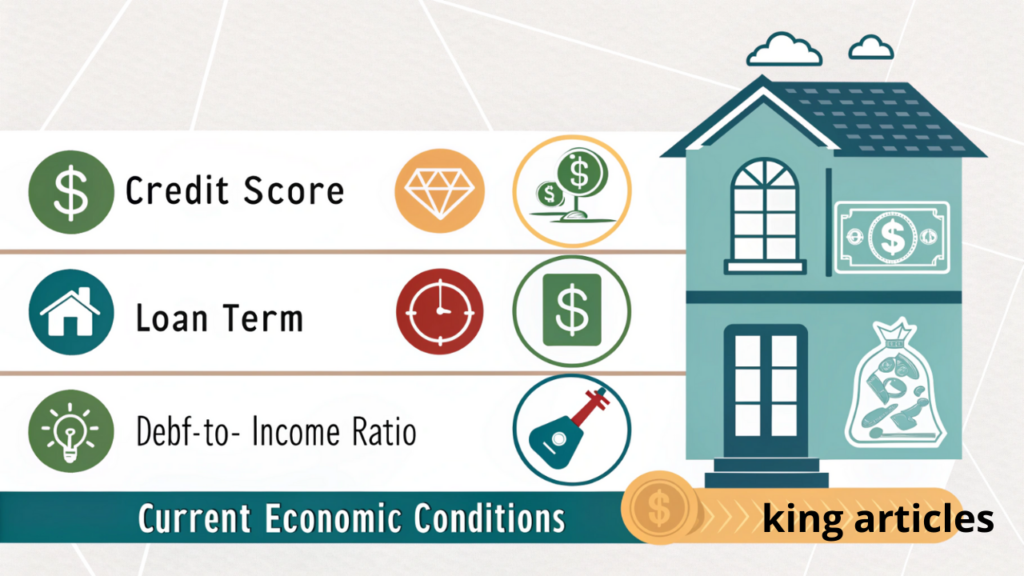
Your quoted interest rate comes from a mix of personal, loan, and market variables, especially when considering refi mortgage rates. Understanding each piece helps you target better pricing and know what to ask a lender.
Borrower profile: credit, income, DTI, and loan-to-value
Your credit score, steady income, and debt-to-income ratio shape the first impression lenders use to set a rate. Stronger credit often means lower interest and better percentage pricing.
Equity matters too. A lower loan-to-value percentage can drop your quoted rate and remove mortgage insurance.
Loan details: loan term, loan amount, points, and property type
Shorter terms usually carry lower interest but higher payments. The loan amount—conforming or jumbo—also alters pricing grids.
Paying points reduces the interest rate today, but compare the upfront amount with the time it takes to recoup that cost.
Market forces: inflation, economic outlook, and lender pricing
Macro trends set base pricing. Inflation and economic forecasts push daily rate moves that each lender converts to offers.
“Compare Loan Estimate details closely so you capture every pricing factor before you lock.”
- Tip: Request multiple quotes and review the Loan Estimate to confirm all fees and adjustments.
Compare refinance loan types to match your goals
Pick the loan structure that fits how long you’ll stay in the home and how much monthly strain you can handle. Below are common options and the situations where each makes sense.
Conventional fixed: 30-year vs. 15-year
A 30-year fixed loan spreads payments and gives the lowest monthly predictability.
Choosing a 15- or 10-year term raises your monthly outlay but cuts total interest and shortens payoff. For a typical conforming amount near $464,000, at least 25% equity usually unlocks the best pricing and removes some insurance costs, making it crucial to consider how these factors influence refi mortgage rates.
Adjustable options: 5/1, 7/6, 10/6
ARMs offer a lower initial rate for a defined period (5, 7, or 10 years) before adjustments begin.
They suit you if you plan to sell or refinance before the first adjustment. Learn the index (often SOFR), margin, and caps so future changes are clear.
Government programs: FHA and VA
FHA refinances can work with as little as 3.5% equity, while VA may allow no equity for eligible veterans.
These options have flexible credit rules, but watch for mortgage insurance or funding fees that affect costs.
High-balance and jumbo solutions
Jumbo loans—commonly around $940,000 or more—may require stronger credit and at least 25% equity.
Both fixed and ARM jumbo products exist; compare interest and fee details side by side to see which matches your timeline and savings goal.
- Compare two programs with the same rate and points assumptions to see monthly and lifetime differences.
- Consider points only if the break-even fits how long you’ll keep the loan.
The true cost of refinancing: interest rate, APR, points, and closing costs
Upfront fees and points can change whether a lower rate truly saves you money. The note rate is the interest you pay on the principal. The annual percentage rate (APR) adds most lender fees and points so you see a fuller percentage cost.
Rate vs. annual percentage rate (APR): understanding the difference
When considering refi mortgage rates, check the rate and APR for the same loan amount and term on the same day. APR reveals fees that raise your overall percentage and affect long-term payments.
Mortgage discount points: when buying down the rate pays off
Points are prepaid interest. Buying one point usually costs 1% of the loan amount and lowers the quoted rate.
Do a breakeven calculation: divide the point cost by the monthly payment savings to get the months until payback.
Typical refinance closing costs and how they affect your breakeven
Closing costs typically run 2%–5% of the loan amount and include origination, appraisal, credit report, title, recording, and any points.
For cash-out loans, loan-level price adjustments can add costs based on LTV and credit. Review the Loan Estimate to confirm required points, optional discounts, and any lender credits.
| Item | Typical % of Loan | Effect on APR | When to consider |
|---|---|---|---|
| Origination fee | 0.5%–1.0% | Raises APR | When lender charges fees instead of credits |
| Discount points | Each point = 1.0% | Lowers note rate, raises upfront cost | If you plan to stay beyond breakeven months |
| Third-party fees (appraisal, title) | 0.5%–2.0% | Raise APR | Standard closing process |
| Mortgage insurance | Varies | Can lower overall monthly payment if removed | If refinance removes MI, accept slightly higher rate |
- Tip: Use a break-even analysis to decide on points based on how long you will keep the property.
- Tip: Confirm the lock period, amount financed, and escrow choices on the Loan Estimate to avoid surprises at closing.
Should you refinance your mortgage now?
A practical way to decide is to compare your projected monthly savings against the cost of closing and the time you expect to stay.
Run the numbers: start by estimating your new monthly payment at today’s rate and subtract your current mortgage payment.
Please create a breakeven timeline by dividing the closing costs by the monthly savings to determine the number of months needed to recoup the fees. If you plan to keep the home longer than that period, the refinance likely makes sense.
Cash-out refinance trade-offs
Expect higher pricing. Cash-out refinance offers often carry higher rates and LLPAs because lenders price added risk tied to LTV and credit.
Many owners with existing rates above 7.5% are refinancing now. Conversely, owners below about 5% often choose a HELOC or home equity loan to avoid resetting a low first lien.
- Consider carefully how much money you truly need to avoid paying interest on unused funds.
- Include potential savings from removing mortgage insurance when improved LTV helps your case.
- Ask a lender for side-by-side scenarios: rate-and-term vs cash-out, with APR and total costs shown.
“A clear year-by-year breakeven helps confirm whether the new payment and costs match your plan.”
How to refinance your mortgage: step-by-step
Begin the process by setting a clear financial target—lower payment, shorter term, or cash out—and work from there. A defined goal helps you pick the right loan and keeps the application focused.
Set your goal and pick a term and rate type
Decide upfront: choose a term and whether you want a fixed or adjustable interest rate. When considering your options, pay attention to refi mortgage rates, estimate breakeven, and confirm the amount of equity you need to meet your plan.
Shop lenders, compare rate and APR, and lock
Get quotes from at least three lenders on the same day. Compare both the quoted rate and APR. Confirm lock periods and any float-down options before you commit.
Prepare documents and submit the application.
Organize tax returns, W-2s, pay stubs, bank statements, and property details. Check credit and fix errors early to improve approval odds.

From application to closing
Expect an appraisal, underwriting reviews, and disclosures. Review the Loan Estimate to verify costs and lender credits. Plan funds to close, insurance updates, and payoff timing so closing goes smoothly.
“Compare identical loan scenarios so you can judge offers fairly before you lock.”
Conclusion
Wrap up your shopping by matching each loan’s payment and lifetime cost to your personal timeline.
Compare loans side by side using both the quoted rate and the APR. Confirm how many points are included and any lender discount programs that change the percentage cost.
Prioritize offers that show the monthly payment and total payment over a set number of years. Verify the total amount financed, cash-to-close, and how insurance or escrow will change your payments.
Act today if a quote meets your goals, especially when considering refi mortgage rates. Locking protects the pricing while you finish documents and keeps your plan on track.
Frequently Asked Questions (FAQ)
What affects the headline rate I see when shopping?
Lenders set the advertised rate based on several factors, including your credit score, loan-to-value (LTV), debt-to-income (DTI), loan term, and whether you pick a fixed or adjustable option. Market forces like inflation and the broader economic outlook also push pricing up or down. Points, lender fees, and property type can change the final offered percentage and the annual percentage rate (APR) you pay.
How does my credit score change the monthly payment I’ll get quoted?
Higher credit scores typically earn lower interest and a smaller monthly payment. Lower scores can trigger higher pricing, added lender pricing adjustments (LLPAs), or even require mortgage insurance for some programs. Improving your score before applying can reduce both the rate and total interest over the life of the loan.
What’s the difference between the interest rate and APR?
The interest rate determines your periodic interest cost and monthly payment. APR includes the interest rate plus certain fees and points spread over the loan term, so it gives a broader picture of the loan’s true cost. Use APR to compare offers when closing costs or discount points differ between lenders.
When does buying discount points make sense?
Buying points reduces your interest rate in exchange for an upfront fee at closing. It makes sense if you plan to keep the loan long enough to recover that cost—the breakeven period—and you have cash available to pay closing costs. If you expect to sell or refinance again soon, paying points may not be worth it.
How do I choose between a fixed-rate and an adjustable-rate loan?
Choose a fixed rate if you want predictable payments and plan to stay in the home for many years. Consider an adjustable rate (such as a 5/1 ARM) if you expect lower rates, plan to move or refinance before the adjustment period, or want a lower initial payment. Compare projected payments, risk tolerance, and how long you’ll keep the loan.
How do closing costs and fees impact my breakeven timeline?
Closing costs—including origination, title, appraisal, and third-party fees—raise the upfront expense of refinancing. Divide those costs by your monthly savings to find the breakeven point. If the breakeven period is shorter than the time you expect to keep the loan, refinancing can be worthwhile.
What is a cash-out refinance, and what should I watch for?
A cash-out refinance replaces your current loan with a larger one and gives you the difference in cash. Watch for higher rates, increased loan-to-value, possible mortgage insurance, and lender overlays. Use equity wisely: pay high-interest debt, invest in home improvements that add value, or consolidate for better overall cash flow.
How do government refinance programs differ from conventional ones?
FHA and VA options often allow more flexible credit and income guidelines and can be useful for borrowers with lower down payment history or special eligibility. They may include mortgage insurance or VA funding fees and have specific appraisal and occupancy rules. Compare program rules, fees, and net cost versus conventional offers.
What paperwork will lenders request during the refinance process?
Expect to provide proof of income (pay stubs, tax returns), asset statements, current loan statements, homeowner’s insurance, and ID. Lenders also verify credit and may require an appraisal. Having documents organized speeds underwriting and reduces surprises that can delay closing, especially when considering refi mortgage rates.
How long does the refinance process take, and what can change during that time?
Typical timelines range from 30 to 45 days. Rates, lender fees, and loan terms can change up until you lock your rate. Appraisal results, title issues, or income verification problems can also delay closing. Lock your rate when you’re comfortable with the offer and after you’ve compared APR and closing costs.
How do I calculate potential monthly savings and whether refinancing is right for me?
Compare your current payment to the new monthly payment after fees. Subtract the new payment from your current one to get monthly savings, then divide your total closing costs by that figure to find the breakeven months. Also consider total interest over the loan term, loan term changes, and whether you’ll pay any prepayment penalties.
Can I refinance if I have a lower home equity or high DTI?
Lower equity and high DTI can limit options and increase pricing or required mortgage insurance. Some streamlined or specialty programs help borrowers with limited equity, but they may carry higher rates or fees. Improving equity, reducing debts, or waiting to build more savings can improve offers.
What should I look for when comparing lender quotes?
Compare the interest rate, APR, points, and itemized closing costs. Ask about rate lock policies, float-down options, appraisal fees, and any lender-specific fees. Evaluate both monthly payment and total cost over the term to choose the best fit for your goals.
Are there situations where you shouldn’t refinance?
Avoid refinancing if closing costs outweigh savings within your planned ownership period, if you’d extend the loan term and pay more total interest without meaningful monthly relief, or if your credit or income will prevent a better offer. Run the numbers first and consider alternatives like loan modification or recasting if available.