
You want fast, clear ways to fund growth and keep operations steady. This introduction explains how smart business lending choices give you timely access to working capital and practical routes to scale. It highlights real offers and what financial institutions look for so you can act with confidence.
Marketplace breadth matters. With 75+ lenders in-network and 16+ years serving small business owners, marketplaces match over 400k firms to options like same-day lines of credit up to $250,000 and SBA 7(a) term loans up to $5 million.
Typical qualification snapshots help you prepare: a credit score near 600+, monthly revenue around $8K+, and six months in operation. You also learn which products suit needs—equipment financing, invoice factoring, revenue-based financing, or term loans—and how speed and amounts differ by product.
Ask targeted questions about rates, fees, covenants, and any loan guarantee or guarantee program details so offers align with cash flow and risk tolerances.
Topic Basics
Why business lending matters for small businesses in the United States
When cash matters, the right credit or loan turns plans into results. Access to capital bridges the gap between opportunity and resources so you can hire, buy equipment, and expand market reach.
From startup needs to scaling, timing and product choice matter. Revolving lines work for repeat purchases and short gaps. Term loans suit larger, defined projects with steady monthly payments.

From startup needs to scaling: when to use credit and loans
- Startup: initial inventory, marketing, and short-term cards or microloans.
- Early growth: lines of credit for working capital and invoice factoring for receivables.
- Scaling: equipment financing, term loans, or SBA 7(a) for larger investments.
You should know typical qualification snapshots: a 600+ credit score, about $8K+ monthly revenue, and at least six months in operation. Discuss requirements with your financial institution early so you understand whether you may qualify now or after a short period of growth.
| Need | Product | Speed | How lenders judge |
|---|---|---|---|
| Repeat purchases | Line of credit | Days to same-day | Revenue, cash flow |
| Large project | Term loan / SBA 7(a) | Weeks to months | Credit score, time-in-business |
| Equipment | Equipment financing | Days to weeks | Asset value, entity stability |
Faster access to financing when timing is everything
Urgent cash needs demand options that deliver funds in hours or days, not weeks. You can choose speed-focused credit paths to meet payroll, rush inventory, or seize short-term deals. Know the tradeoffs so you move fast without surprises.
Same-day to near-term funding: lines of credit, revenue-based financing, and factoring
Same-day lines of credit and revenue-based offers provide quick access. Examples include Idea Financial (line up to $250,000, min 650), Headway Capital (up to $200,000, min 615), and OnDeck (revenue-based up to $250,000, min 625).
Invoice factoring and quick cash advances can fund invoices in 1–2 business days. Gillman-Bagley and Eagle Business Funding offer fast factoring up to multi-million-dollar limits. Kapitus and QuickBooks Capital also move funds in one to two days, though third-party checks can affect timing.
Predictable timelines for SBA and term loans
Term loans and SBA 7(a) are often more predictable. Some financial institutions—Cadence Bank and BayFirst Financial—can fund large loans within days when documentation is complete. Expect more paperwork but generally lower cost than rapid cash advances.
- Compare speed vs. cost: fast options cost more but can save urgent opportunities.
- Use a line of credit for flexible draws; use a term loan for big, planned projects.
- Prepare credit and revenue documents ahead to avoid delays from third-party verification.
Flexible products designed to assist different business needs
Select funding instruments that align with use, risk, and repayment rhythm. A well-chosen mix lets you cover recurring costs, buy assets, or bridge slow pay cycles without overpaying for speed.

Revolving credit lines that fit repeat purchases and seasonal stock. Term loans and SBA 7(a) work for defined projects and expansions with predictable monthly payments.
Equipment financing ties payments to an asset’s useful life. Invoice factoring converts receivables into near-term cash without adding traditional debt.
- Credit cards handle daily expenses and build a profile when used carefully.
- Revenue-based advances trade future receipts for speed when cash is time-sensitive.
- Microloans suit early-stage needs with simpler docs; commercial mortgages fund property moves.
Financial institutions evaluate each option differently—revolving usage, amortizing schedules, or advances secured by sales. You expand access when you document revenue, time in operation, and responsible credit habits.
Tip: Stack products: use a line for inventory, a term loan for expansion, and factoring when customers pay slowly. Designed assistance features, like guarantees or collateral, can improve approval odds.
Stabilize cash flow with working capital options
Short-term capital tools fill gaps so daily operations run without interruption. Use targeted options to cover payroll, restock inventory, or handle routine bills without draining reserves.
Bridging gaps for payroll, inventory, and everyday expenses
Lines of credit give revolving access and let you draw only what you need. That keeps interest costs lower when cash is tight.
Revenue-based financing provides swift funds in exchange for a portion of future sales. It suits short liquidity swings when you expect steady receipts.
Invoice factoring unlocks cash from unpaid invoices so you don’t wait 30–90 days. A reliable financial institution will determine credit limits based on your receivables, bank statements, and credit history.
- Match the tool to the gap: payroll, inventory, or operating expenses.
- Watch repayment cadence and total cost to avoid overleveraging next month.
- Keep unused line capacity and track draws to handle surprises.
- Build a relationship with your financial institution to expand limits as revenue grows.
Build business credit and expand your borrowing power
A strong credit profile helps you unlock larger limits and better pricing as you grow.
Use small, consistent steps to show repayment reliability. On-time payments on a line of credit and a single business credit card create trade lines that a financial institution reviews when you apply for larger products.
Using credit cards and lines of credit to strengthen your profile
Separate personal and commercial spending so your personal score stays protected and your records are clean for underwriting. Many underwriters may require bank statements, tax returns, and proof of revenue.
- Pay balances on time to improve your business credit and lower future pricing.
- Keep utilization low and use rewards or reporting features to track expenses.
- Compare fees versus float and card benefits to match your cash cycle.
- Combine revolving accounts with installment loans to diversify your credit mix.
| Tool | Primary benefit | What underwriters look for |
|---|---|---|
| Business credit card | Rewards, daily spend tracking | Payment history, utilization |
| Line of credit | Revolving access, shows consistent draws | Bank statements, repayment pattern |
| Mixed strategy | Improves credit mix and limit growth | Multiple positive trade lines, revenue trends |
Product roundup: compare top business lending options and what they’re best for
This roundup helps you quickly compare common products and what each fits best. Use it to match the type of funding you need so you can manage cost, term length, and operational impact.
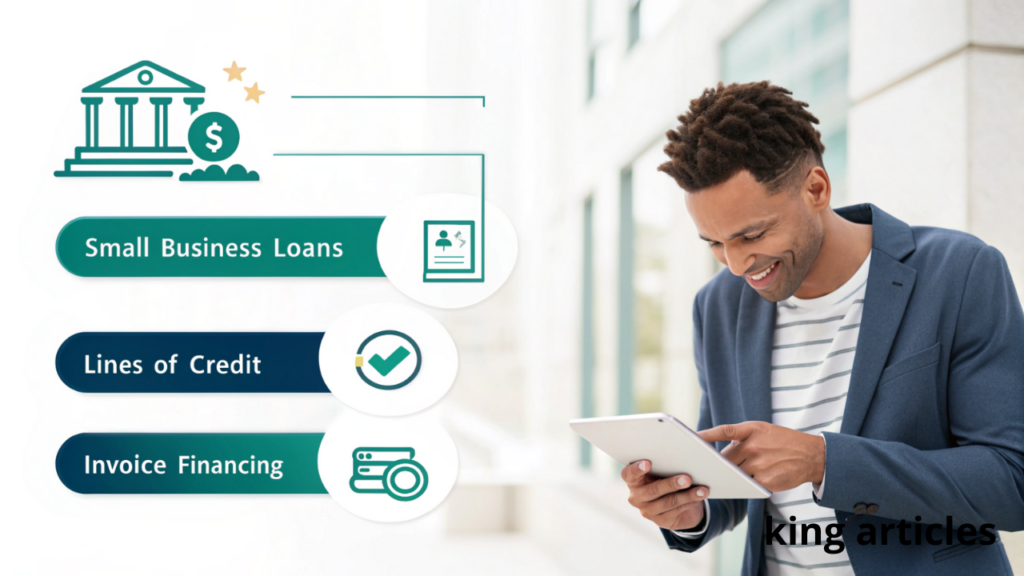
Business line of credit: revolving access up to $250,000
Best for: short-term gaps and repeat purchases. QuickBooks Capital and Idea Financial offer quick draws from $1,000 to $250,000. Draw only what you need to control interest.
Term loans: lump sums with predictable monthly payments
Best for: defined projects. Providers like BHG and iBusiness Funding fund $25,000–$500,000 with set schedules that aid budgeting.
SBA 7(a) loans: up to $5 million for diverse uses
Best for: larger expansions and favorable long terms. Cadence Bank and BayFirst Financial handle amounts up to $5M for working capital, real estate, and more.
Equipment financing
Best for: tools, vehicles, and machinery. Balboa and ClickLease cover small to multi-million-dollar needs while aligning payments to asset life.
Speed options: revenue-based financing and cash advances
Best for: fast access when timing matters. Kapitus and OnDeck provide advances up to $750K and $250K in exchange for a portion of future sales.
Invoice factoring
Best for: unlocking receivables. Gillman-Bagley and Eagle Business Funding advance $50K–$10M against invoices to free up cash faster than some loans.
Everyday tools: credit cards, microloans, and commercial mortgages
Use credit cards and small lines to build business credit while covering routine spending. Microloans suit startup needs. Commercial mortgages fund property purchases and refinancing.
“Choose the product that fits your cash cycle, not the first offer you see.”
- Compare how each financial institution underwrites risk—marketplaces of lenders improve fit.
- Align product to use: payroll, equipment, or real estate to control cost and impact.
Government-backed programs and loan guarantees that broaden access
Government backing often changes an underwriter’s view of risk quickly.
Why guarantees matter: A federal or agency guarantee reduces exposure for a financial institution and can unlock credit for firms that might not otherwise qualify.
Small Business Administration support
The Small Business Administration backs many uses, including SBA 7(a) loans up to $5 million. That support often means longer terms and more competitive rates, which can lower your monthly burden.
USDA: B&I and REAP for rural and energy projects
USDA B&I mitigates lender risk to spur rural economy growth. REAP guarantees funding for renewable and efficiency projects, aligning public goals with private credit.
EXIM Working Capital Loan Guarantee
EXIM can guarantee up to 90% of a loan for export-related working capital. This helps you fulfill foreign orders with confidence.
FSA and Indian Loan Guarantee Program
FSA offers operating, farm ownership, and emergency farm loans for producers. The Indian Loan Guarantee Program helps eligible Native-owned entities (51%+ owned) access finance by reducing lender risk.
“Loan guarantees bridge public policy goals and private capital, helping local employers grow.”
| Program | Primary benefit | Typical coverage |
|---|---|---|
| SBA 7(a) | Longer terms, lower rates | Up to $5,000,000 |
| USDA B&I / REAP | Rural and energy project support | Partial risk mitigation |
| EXIM Working Capital | Export working capital | Up to 90% guarantee |
| FSA | Operating, ownership, emergency farm loans | Program-specific limits |
| Indian Loan Guarantee | Support for Native-owned entities | Partial lender protection |
Tip: Prepare documentation early. Each program has criteria a financial institution will verify before approval, and satisfactory files move faster.
Spotlight: California IBank Small Business Loan Guarantee Program
A state-backed guarantee can turn a marginal application into an approvable credit request. IBank’s Small Business Finance Center supports statewide growth through a targeted guarantee program that helps expand access to capital.
How loan guarantees help you qualify and create jobs
Loan guarantees reduce a financial institution’s exposure so lenders can extend more credit to qualified applicants. That shared risk often improves odds of approval and can lower barriers for firms with limited history.
Since FY13–14, IBank has supported $2.5 billion in small businesses and helped create or retain 469,523 jobs. In FY23-24, the program supported $366 million in loans. 760 guarantees impacted 14,349 jobs in FY 22-23.
Eligible uses: startup costs, construction, inventory, lines of credit, and more
The loan guarantee program covers many uses: startup costs, construction, inventory, working capital, agriculture, and lines of credit. Eligible applicants range from sole proprietors to corporations and nonprofits—entities with 1–750 employees may include qualifications.
- How it helps: The program helps a lender stretch credit terms when underwriting alone might fall short.
- Seven regional partners process guarantees and offer technical assistance for documentation.
- Engage a lender familiar with IBank to match your credit profile to the right guarantee structure.
“A public guarantee can translate into real hiring, retention, and growth outcomes for your team.”
Benefit from lender marketplaces and networks
A marketplace of lenders helps you compare options quickly and pick the path that fits your timeline. Use that centralized view to avoid repeating paperwork and to see real offers side by side.
75+ lenders in-network and hundreds of thousands matched
Scale matters: with 75+ lenders and 400k+ matches over 16+ years, you gain faster access to multiple product types.
That network includes banks, fintechs, and specialty financial institutions so you can weigh cost, speed, and documentation needs.
Choosing the right lender, product, and timeline for your goals
Prepare one clean package of bank statements, tax filings, and a short use plan. Share it once and let the marketplace route your file to multiple providers.
- Compare rates and prepayment rules to lower lifetime cost.
- Account for third-party verification steps that affect time to funds.
- Map expected approvals to key project dates so financing aligns with milestones.
“A marketplace increases match rate while reducing duplicate effort.”
| Marketplace benefit | What you get | Best for |
|---|---|---|
| Wide lender mix | Banks, fintechs, specialty funders | Balance cost and speed |
| Single submission | One package, many reviews | Faster discovery |
| Comparative terms | Side‑by‑side rates and fees | Lower lifetime cost |
Who may qualify: typical requirements lenders may include
Underwriters look for a few clear indicators before moving forward with an offer. Knowing those signals helps you decide if you should apply now or strengthen your file first.
Credit score, monthly revenue, and time-in-business snapshots
Baseline requirements many lenders may include are a credit score near 600+, monthly revenue of about $8K+, and at least six months in operation. These metrics show basic repayment ability and track record.
Documentation underwriting may require financial statements, recent tax returns, bank statements, and entity formation records. A clear package speeds review across each financial institution you approach.
- Personal guarantees from an individual owner can affect approval and pricing for a small business loan.
- Seasonality, margins, and existing debt shape how a lender gauges cash flow and eligibility.
- If metrics fall short, consider waiting a quarter, adding collateral, or trimming obligations to improve odds.
Right-size the loan by confirming how lenders interpret cash flow coverage and debt service. That prevents overborrowing and keeps payments sustainable.
Assemble one clean file and share it with multiple reviewers in a marketplace. High-quality documentation reduces back-and-forth and speeds decision-making by lenders and each financial institution that reviews your request.
“Clean files move faster; small gaps often cause the biggest delays.”
Use cases by entity type and industry
How you organize your company affects which products fit and what underwriters request. Your entity type guides required documents, guarantees expectations, and acceptable collateral. That helps you pick terms that match seasonal cash flow and repayment ability.
Sole proprietorships, LLCs, corporations, cooperatives, and partnerships
If you operate as a sole proprietorship, expect simpler formation records but more personal exposure when making credit decisions. A limited liability company separates many personal assets, which changes how a financial institution assesses risk.
Corporations and cooperatives present formal ownership records and can access program options that favor organizational structure. Partnerships need clear ownership agreements to speed underwriting.
From farms to retail: inventory, equipment, and working capital
Use cases vary by industry. A farm may use loans for seed, feed, and repairs. Retailers often prioritize inventory and lines that cover seasonal demand.
Tip: Document inventory and equipment needs in detail so a financial institution can price risk and offer terms aligned to your plan.
- Match tools to entity: sole proprietorships and LLCs may need owner guarantees; corporations can use corporate collateral.
- Tailor repayment to seasonality so cash flow stays stable through slow months.
- NAICS codes, ownership records, and clean statements speed review by each financial institution.
“Structure your file to mirror how the underwriter reads risk: entity, owners, cash cycle, and collateral.”
Risk management: how loan guarantees reduce lender risk and help you access funds
Guarantees from federal and state programs change how a financial institution prices and accepts risk. When a guarantor covers part of a potential loss, a financial institution can approve credits it might otherwise deny.
This shift in risk can lower rates or extend terms through a formal guarantee program, making business lending more affordable and within reach for more firms.
- A loan guarantee shifts default risk from the lender to the guarantor, improving approval odds.
- Ask your lender about specific programs tied to use cases—EXIM for exports, USDA B&I for rural projects, or state-level options like IBank.
- Credit, collateral, and cash flow still matter: guarantees help, but strong documentation raises approval chances.
- Prepare bank statements, tax returns, and a clear use plan early; both the financial institution and program admins will review details.
- Confirm how guarantee fees and conditions affect total cost so you can compare offers accurately.
“A well-structured guarantee can expand access while keeping repayment sustainable.”
Navigating compliance: what the small business lending rule firewall means for you
Regulatory rules now create clear limits on who at a financial institution may see sensitive applicant demographics during a credit review. The rule aims to protect privacy while keeping reviews efficient and fair.
Privacy protections around demographic data collection
Under 12 CFR 1002.108, financial institutions must prevent employees who make decisions on applications from seeing protected demographic information unless there is a specific reason to allow it. This reduces unnecessary exposure to an individual’s data.
When employees “should have access” and the required notice
Each financial institution decides who “should have access” based on assigned duties. Roles like loan officers and compliance staff commonly need it, while executives with no assigned review tasks usually do not.
You may receive a notice if the institution relies on the exception. That notice explains who will view demographics and why.
- You learn how the firewall limits who at a financial institution can view protected demographic data during credit decisions.
- Only employees assigned specific duties may view this data, and the institution must give required notice when using an exception.
- These requirements apply in the United States and protect fairness in small business credit reviews.
“If you have questions about who saw your demographic data, ask the financial institution for their notice and role list.”
Maximize ROI: match financing to growth moves
Align funding choices to project payback so each dollar you borrow adds measurable return. That focus helps you avoid high lifetime costs and keeps cash flowing through expansion.
Choose the right product for the job. Use equipment financing from Balboa (up to $2M) or ClickLease (small-ticket) for machinery upgrades so payments mirror asset life.
Equipment upgrades, hiring plans, and market expansion
For new locations, a term option or an SBA 7(a) supports larger capex and carries lower monthly strain. Consider a business loan or small business loan when you need lump-sum funding for buildouts or marketing scale.
- Use working capital to hire and onboard steadily without draining reserves.
- Reserve cash advances for urgent wins; avoid them for long-term projects.
- Run small tests on a credit card, then move winners into longer financing to cut costs.
- Plan repayments around seasonality or farm cycles to prevent shortfalls.
Benchmark offers across providers like Kapitus and OnDeck when speed matters, and refinance later if improved metrics lower your rate. Track ROI after funding and sequence draws to maximize returns.
Conclusion
Finish by turning options into actions that protect cash flow and growth. , Keep a clear use plan, prepare clean bank statements and tax files, and list the questions you will ask each lender about rates, fees, and covenants.
Use speed where needed—same-day lines and equipment financing solve urgent gaps, while SBA 7(a) and term choices fit long projects. Tap government programs like SBA, USDA, EXIM, FSA, or state options such as IBank when a loan guarantee program can widen access. Share one solid package with marketplaces that connect 75+ lenders and 400k+ matches built over 16+ years to speed review by a financial institution.
Balance urgency and cost, and treat each credit decision as a step toward stronger limits and a healthier economy. Stay disciplined on repayment and build a relationship with your lender so future loans and a business loan come with better terms as you grow.
Frequently Asked Questions (FAQ)
What are the top benefits of access to credit for entrepreneurs?
You gain working capital to cover payroll, inventory, and day-to-day expenses. Access to funds helps you invest in equipment, expand to new locations, and hire staff. It also lets you smooth seasonal cash flow and seize growth opportunities without sacrificing ownership.
Why does this type of financing matter for small businesses in the United States?
It bridges gaps when revenue lags or demand surges. Lenders and loan guarantees increase the pool of funds available, helping firms of all sizes sustain operations, create jobs, and compete. Government programs and financial institutions often improve terms for eligible borrowers, broadening access.
When should you use credit or a loan—from startup needs to scaling?
Use short-term credit for inventory buys, payroll, or an unexpected expense. Choose term loans for defined projects like expansion or equipment purchases. For scaling, consider lines of credit to manage ongoing working capital and business credit cards for everyday spending that builds a borrowing profile.
How quickly can you get funded when timing is critical?
Options like lines of credit, revenue-based financing, and factoring can provide same-day to near-term access. These products trade speed for higher costs or fees. SBA loans and traditional term loans take longer but offer predictable timelines and typically lower rates.
What flexible products are available to meet different needs?
You can choose revolving lines of credit, term loans, equipment finance, invoice factoring, revenue-based advances, microloans, and business credit cards. Each product targets different goals—short-term cash needs, asset purchases, or long-term capital—so match the product to the use.
How can working capital options stabilize your cash flow?
Working capital products let you bridge timing gaps for payroll, replenish inventory, and cover routine expenses. A line of credit smooths receipts and payments, while invoice factoring turns outstanding invoices into immediate funds to maintain operations.
How do you build business credit and increase borrowing power?
Use business credit cards and small lines of credit responsibly, pay on time, and keep utilization low. That creates payment history and trade lines that lenders review when evaluating larger requests like term loans or commercial mortgages.
What are the main loan and credit options, and what are they best for?
Lines of credit provide revolving access up to roughly $250,000 for working capital. Term loans deliver lump sums with predictable payments for expansion or equipment. SBA 7(a) loans reach up to $5 million for many uses. Equipment financing purchases machinery, while revenue-based funding or cash advances speed capital delivery in exchange for a portion of future sales. Invoice factoring frees cash tied to receivables. Credit cards handle daily spending and rewards, microloans serve startups, and commercial mortgages finance property.
How do government-backed programs and guarantees broaden access?
Agencies like the Small Business Administration and USDA provide guarantees that reduce lender risk, making them more willing to finance higher-risk applicants or offer better terms. EXIM supports exporters, FSA assists farms, and state programs can guarantee local loans to spur job creation.
How do loan guarantees help you qualify and support job creation?
A guarantee covers a portion of a lender’s loss if you default. That encourages lenders to approve loans they might otherwise decline. As a result, you can secure financing for startup costs, construction, inventory, or lines of credit that help sustain and grow payroll and operations.
How do lender marketplaces and networks benefit you?
Marketplaces match you to dozens of financial institutions and loan products, speeding comparison of rates, timelines, and eligibility. They help you find the right lender and product for your revenue, credit score, and timeline without contacting each bank individually.
Who typically qualifies, and what requirements do lenders include?
Lenders commonly review credit score, monthly revenue, time in operation, and ownership structure. They may request tax returns, bank statements, and personal guarantees. Government programs often have additional eligibility rules tied to industry, location, or mission.
Do different entity types and industries have specific use cases?
Yes. Sole proprietorships, LLCs, corporations, cooperatives, and partnerships each face distinct documentation and liability considerations. Farms may use FSA farm loans for operating or ownership needs, retailers focus on inventory and POS financing, and manufacturers prioritize equipment loans.
How do loan guarantees reduce lender risk and help you access funds?
Guarantees shift part of the credit risk away from the lender to the guarantor, improving approval odds and often lowering required collateral. This enables borrowers who might otherwise face rejection to access capital.
What compliance and privacy rules should you expect when applying?
Rules regarding the collection of demographic data protect borrower privacy and require clear notices about who may access sensitive information. Lenders also follow federal and state regulations to prevent discrimination and ensure transparent terms.
How should you match financing to maximize ROI for growth moves?
Choose financing that aligns with the investment’s timeline and return. Use equipment finance for productivity upgrades, term loans for fixed-cost expansion, and lines of credit for recurring working capital. Compare the cost of capital, the repayment schedule, and the impact on cash flow before committing.